

Look at your desk for a second. Not the screen. The actual desk.
Somewhere on it, there's a small object that has no business still being there. A keychain you don't use. A figurine from a vacation you took in 2017. A pebble. A bottle cap. Something a friend gave you that you don't really need but also can't quite throw away.
That object has survived every desk reorganization, every move, every "I really need to declutter" moment. It keeps making the cut. You don't even think about it anymore. It's just there.
That's the most interesting object on your desk.
The stuff we keep tells us things
There's a whole field called neuroaesthetics that studies why certain objects move us. The short version: physical objects carry feelings, and the feelings outlast the function. The pen runs out of ink. The mug breaks. But the thing your grandfather gave you keeps sitting on the shelf for thirty years because it isn't really about the object. It's about the loop it closes in your head every time you look at it.
We make small objects for a living. So we think about this a lot. The question that drives almost everything we design is: what would make someone keep this?
Not what makes someone buy it. What makes someone keep it.
The keepers have a few things in common
After making hundreds of small things and watching which ones become "the object that refuses to leave the desk" and which ones get quietly stashed in a drawer, here's what we've noticed.
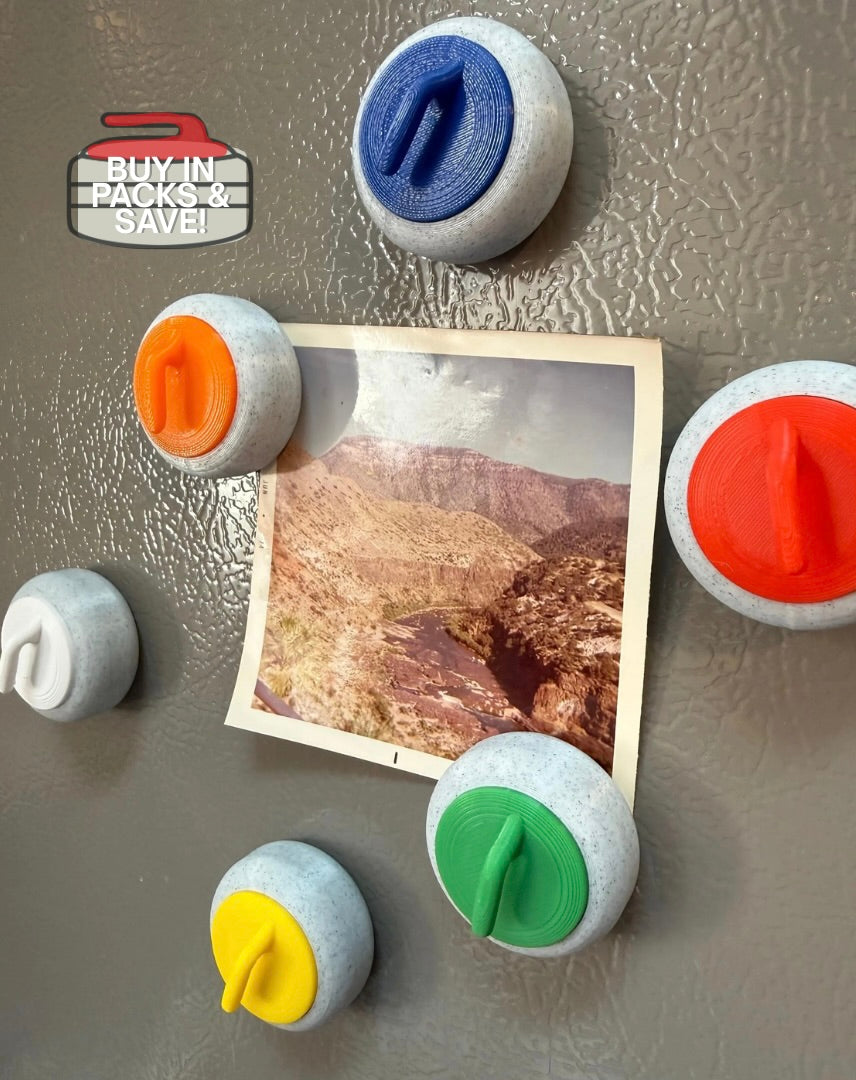
They're specific. Generic objects get cycled out. Specific ones get kept. A magnet shaped like "a flower" goes in a drawer eventually. A magnet shaped like a curling stone, owned by the one person you know who watches curling, stays forever.
They reference something the person already loves. The object doesn't create the meaning. It points at meaning that's already there. That's why the rock from the trail you hiked with your dad is sacred and the rock from the parking lot isn't.
They're small. Big sentimental objects become clutter. Small ones become quiet companions. There's a reason most of what survives long-term is desk-sized or smaller.
They make you smirk a little. Pure sentimentality fades. Sentimentality plus a slight inside joke lasts. That's the spine of every product we make, honestly. We want the object to land with a small smile, not a big swelling soundtrack.
What this means for the stuff you bring into your life
Next time you're about to buy something for your desk, or somebody else's, run it through one filter: is this specific to the person who will own it? If yes, get it. If no, skip it. Generic doesn't survive.
And if you're looking at the object on your desk right now, the one you can't explain to anyone else, don't apologize for it. That object is doing work. It's a tiny private monument to something the rest of the world doesn't need to understand.
Keep it where it is.
Drop us a note on Instagram and tell us what your refuses-to-leave-the-desk object is. We're collecting them.
0 comments