

There is an entire field of research called neuroaesthetics.
It's the study of how the brain responds to beauty, design, and meaningful objects. It looks at things like why certain shapes calm us down, why specific colors lift our mood, why a particular configuration of lines on a page can produce a measurable shift in heart rate.
We think about this a lot. Probably more than is strictly necessary for two people who make small 3D-printed things in a garage. But neuroaesthetics is, in a quiet way, the spine of why we make what we make. Today we want to talk about it.
The thing nobody quite tells you about objects
The conventional way to evaluate an object is functional. Does it do its job? A spatula flips eggs. A radius gauge measures a curve. A magnet holds paper to a fridge. The end.
This is true. It is also incomplete. Because the objects in your physical environment are doing a second job at the same time, a job that doesn't show up on the receipt. They're regulating your nervous system.
Specifically: the objects in your line of sight, repeatedly, throughout the day, influence your mood, your focus, your sense of calm, and your sense of place. The research on this is extensive. Hospital patients in rooms with views of nature heal faster. Workers in offices with personal objects on their desks report higher job satisfaction. People who curate their home environment thoughtfully report lower baseline stress.
The objects are doing measurable work. The work just isn't measured in spatula-flips.
Why this matters for what we make
We make two kinds of things at ThingsForge.
The first kind is functional in the obvious sense. The fillet radius gauge set we sell is a working tool for makers — it measures curves, full stop. The monstera leaf bottle opener opens bottles. Our desk organizers organize a desk. These are tools. They earn their place by doing a job.
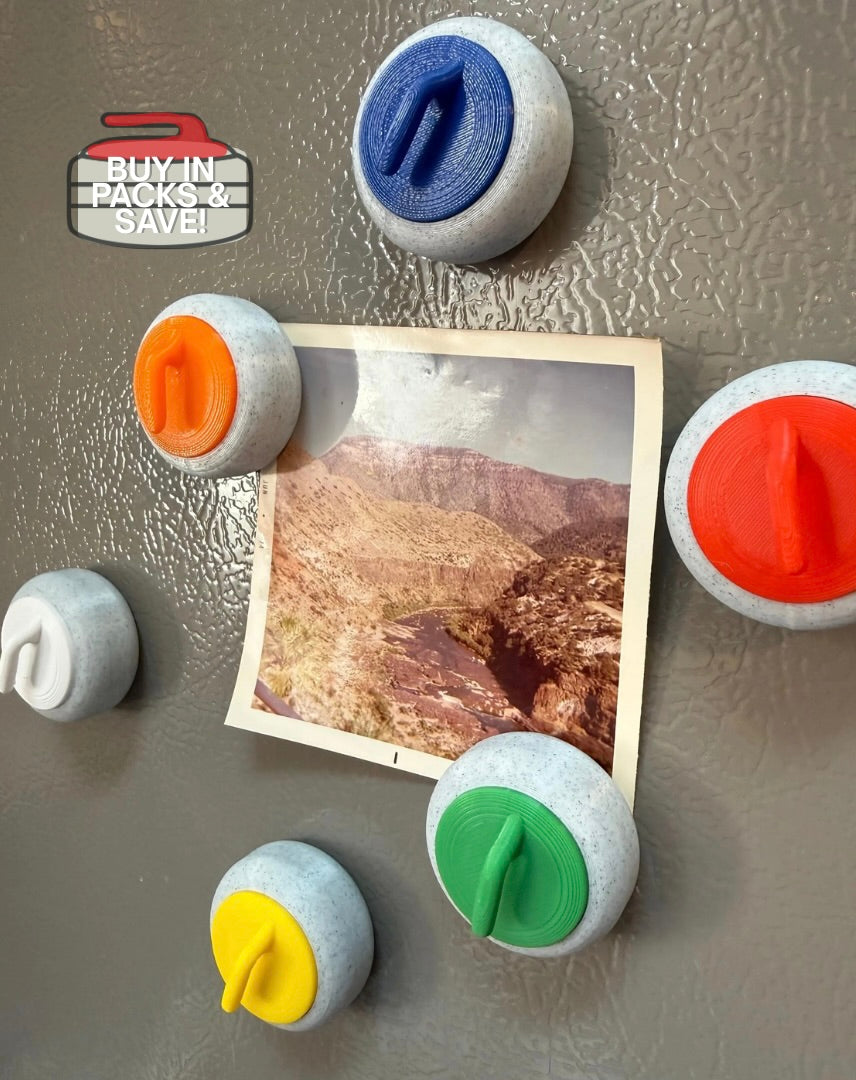
The second kind is functional in the neuroaesthetic sense. The Moodsters, the curling stone magnets, the building block flowers, the bouldering hold magnets — these don't have a mechanical job. They have a nervous-system job. They sit in your visual field, they produce a small specific feeling each time you see them, and they contribute, in a measurable way, to the emotional weather of the space they're in.
Both are real work. We don't think one kind is more valuable than the other. We just want to be honest about which kind a given object is doing.
What makes a small object actually work
Based on neuroaesthetics research and our own experience designing objects for years, here is what we think makes a small object successful in the second sense — the nervous-system sense.
Specificity. Generic objects don't trigger a clear response. The brain processes them as decoration and files them away. A specific object — one that references something the viewer cares about — triggers recognition, which is a much stronger neurological event than mere visual interest. A magnet shaped like "a flower" is decoration. A magnet shaped like a curling stone, owned by someone who watches curling, is a hit of recognition every time. The second one does measurably more work.
Personality. Objects with clear personality — even a small one — engage the brain's social-perception circuits. We respond to characterful objects partly as if they were tiny people. This is why a Moodster on your desk produces a different feeling than an abstract sculpture, even if both are roughly the same size. The Moodster is, neurologically speaking, a small social presence. The abstract sculpture is not.
Familiarity that grows. The best objects are the ones whose appeal deepens over time. First impression isn't everything. Some objects peak on day one and fade. Others reveal themselves slowly and become indispensable by month six. We design for the second kind. The brain forms attachment to objects through repeated exposure plus emotional association, which is why the magnet you've had for three years can feel essential while the one you bought yesterday feels neutral.
Story. Objects with backstory carry more weight. The brain is a storytelling machine, and an object that fits into a narrative — "my partner bought me this for our anniversary," "this is from the shop we visited in Kansas City," "this represents my hobby" — gets encoded differently than an object without one. We try to give every product we make a small story, even if it's just a name and a personality. The story is the neurological glue.
The deeper point
We bring this up because productivity culture has been quietly hostile to small decorative objects for years. The dominant message is: clear your space, minimize, reduce, optimize. Anything that doesn't earn its place mechanically is clutter.
We think this misreads how brains work. The small object on your desk that produces a tiny moment of feeling every time you see it is not clutter. It's a low-grade emotional anchor. It's doing exactly what it should be doing. The research backs this up. The data is clear.
You are allowed to have small objects in your environment that exist purely to make you feel something. They are working harder than they look.
What this looks like in our shop
Both kinds of work are represented.
If you want a tool — something with a clear mechanical job — we have those. The radius gauge set, the bottle opener, the desk organizer, several other practical items that are honestly underrepresented in our marketing because the emotional products get the spotlight.
If you want a small neuroaesthetic anchor — an object whose job is to sit in your visual field and quietly produce a feeling — we have those too. The Moodsters, the curling stones, the bouldering holds, the block flowers. Each one designed (or in the Moodsters' case, named and characterized) to do specific emotional work for the right viewer.
Pick the kind of work you need. Pick the object that does it. The science is on your side.
0 comments